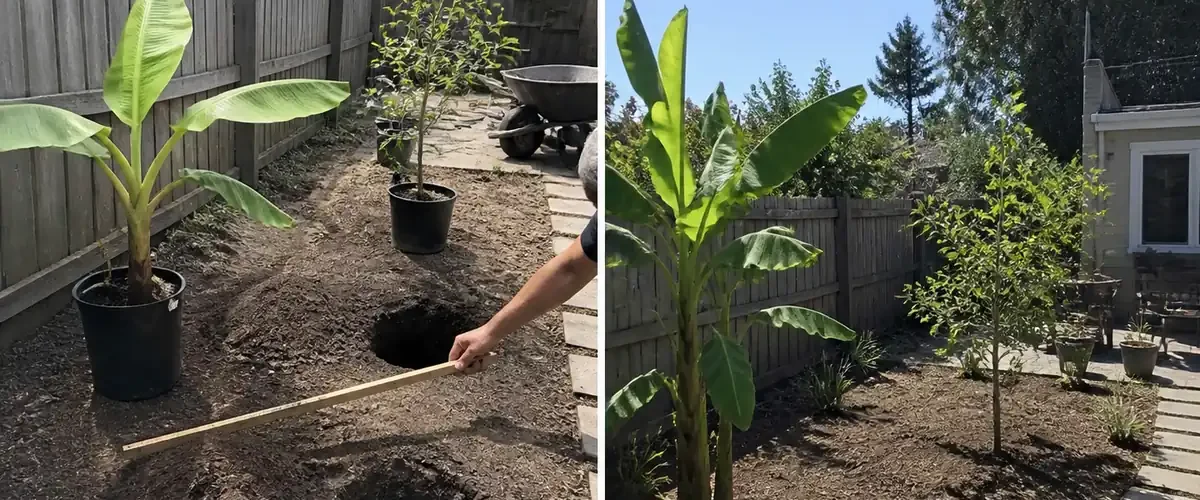
One backyard can hold a lemon and a banana when a clear strip of sky stays between their future crowns.
The article A Guide to Growing Lemons Among Banana Plants suggests planting lemon trees close among banana plants as though shared tropical conditions make clearance and root competition irrelevant. The tempting promise is that lemon and banana plants thrive side by side in one tight planting with the same watering routine.
Plan the Short Wait and Return: Recheck Shade as the Banana Canopy Rises
Waiting plan: bananas can build a tall crown quickly in warm weather, while a young lemon establishes more slowly. Recheck shadow and watering each season. Moving a tree later is costly, so generous first-day clearance produces a bigger long-term finish than a tight tropical-looking cluster.
Leave the tropical pair setup simple during the tropical pair sun-and-clearance plan. Give the crown gap good airflow. Review the tropical pair once as planned. For this tropical pair, skip late ingredients in the planting map.
Compact proof: Take one photograph from the winter-sun side and repeat it as banana leaves expand. Direct light on the lemon, open access, dry trunk bases, and independently moist root zones show the layout is holding.
Leave Four Problems Outside: Four Crowding Errors That Steal Long-Term Growth
- Putting both plants in one hole. One shared pit concentrates competition and makes independent watering almost impossible.
- Using tight trunk spacing. Nursery-size clearance ignores the broad banana leaves and long-lived citrus crown that will follow.
- Giving both one watering rhythm. Bananas often use water rapidly while citrus roots still need air and protection from chronic saturation.
- Pruning severely to repair crowding. Hard pruning after crowding removes productive crown and cannot move two competing root systems apart.
Close the Job Without Risk: Plan Around Utilities and Heavy Banana Stems
Compact cleanup: review underground and overhead utilities before digging. Site tall bananas away from power lines and structures, use safe tools and lifting, and plan for heavy spent pseudostems. Follow local citrus-disease restrictions and all fertilizer and pesticide labels.
Collect marking stakes, store digging tools, clear the path, and keep both planting zones open for safe future access.
Use the Compact Six-Step Setup: Give Lemon and Banana Separate Paths to Sun
- Draw mature canopies
- Mark expected widths for the exact banana and lemon cultivars, buildings, paths, power lines, and access.
- Track the sun corridor
- Observe morning through afternoon light and keep the future banana crown from blocking the lemon’s sun.
- Test both drainage zones
- Dig and water test holes separately because the best position for one root system may stay too wet for the other.
- Plant in separate holes
- Give each plant its own amended-free native-soil root area at the correct depth rather than sharing one pit.
- Separate water and feeding
- Use independent emitters and adjust them as roots, heat, rain, and crop size change.
- Prune and reassess shade
- Clear away spent banana stems safely, manage extra suckers, and correct only branches truly blocking access or light.
Let Each Item Earn Its Place: Why Shared Warmth Does Not Mean Shared Root Care
The small crown gap setup works for a clear reason: sun powers both crops, but banana leaves rise and spread much faster than a young citrus crown. Independent root zones allow different watering decisions, while an open corridor keeps light and air reaching the lemon. Generous clearance prevents an attractive first-year grouping from becoming a shaded contest.
This compact tropical pair routine succeeds through mapping mature crowns, preserving full sun, testing water escape, planting in independent root zones, controlling watering independently, and reassessing shadow as banana stems multiply. Its unused shortcut can leave the shelf.
Keep the Small Promise Honest: The Tropical Pair Works Only When Both Canopies Breathe
Both crops appreciate warmth and sun, but a fast banana crown can shadow citrus and their roots do not need the same watering rhythm. Lemon trees commonly need generous clearance from other trees, often about fifteen to twenty-five feet depending on variety and system. Banana clearance also changes with variety. They can share a backyard when each plant keeps its own root area and sun corridor.
For one contained tropical pair job, aim for a healthy lemon and banana grouping with open sky between crowns, independent watering zones, and vigorous believable growth without one plant smothering the other. Begin the tropical pair sun-and-clearance plan with no extra material in the crown gap work spot.
Clear and Read One Space: Map Mature Size Before Digging Either Hole
Small-space review: identify both cultivars and estimate mature height and width, not nursery size. Map sun through the day and across seasons. Test water escape in both planting areas, locate buildings and utilities, note prevailing wind, watering reach, root competition, disease restrictions, access for harvest, and safe removal of banana stems.
Clear bottles and tools from the planting map. On the tropical pair sun-and-clearance plan surface, keep the crown gap and its light readable. Keep tropical pair moisture and cleanup simple.
Let Few Gardeners Know the Secret to Growing Lemons With Bananas Become the Tropical Pair Win That Stays
Begin the tropical pair sun-and-clearance plan by drawing the mature crowns. Keep the tropical pair area uncluttered and aim for a healthy lemon and banana grouping with open sky between crowns, independent watering zones, and vigorous believable growth without one plant smothering the other. That practical crown gap finish leaves one healthy tropical pair routine. The unused shortcut leaves the planting map.