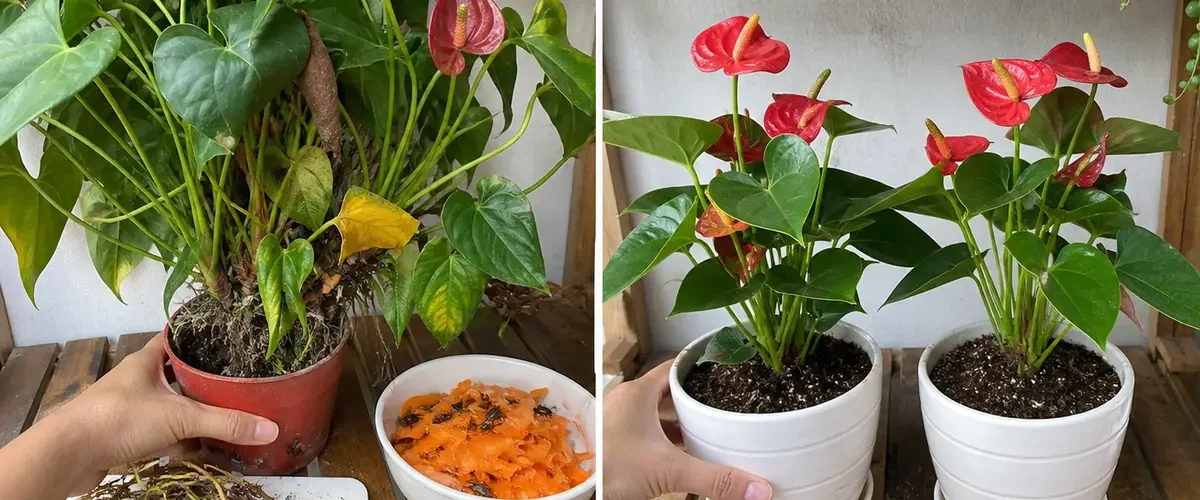
One top-heavy anthurium can become two balanced shelf plants when the roots already define the split. Una bomba natural para la floración de Anthurium: podría durar hasta 15 años proposes carrot water being offered as a natural bloom bomb that keeps an anthurium flowering for fifteen years and claims that a carrot-based treatment guarantees spectacular anthurium flowers for up to fifteen years.
A contained crown renewal can deliver one aging crowded anthurium renewed into several vigorous flowering crowns.
Start Here: Compact Start: Prove Division Is the Right Move
At one tidy work station, record crown count, separate rooted sections, stem firmness, aerial roots, root health, pot stability, mix collapse, drainage, moisture, leaf size, flower history, pests, disease, light, warmth, humidity, fertilizer, and whether crowding or an unstable aging stem actually justifies division.
Clear a small anthurium crown-renewal split work zone and protect nearby floors, fabrics, plants, food, and shared air. Test one subject or one hidden area before treating the entire space.
What the Bold Anthurium Crown-Renewal Split Claim Leaves Out
For a compact setup, the practical limit is clear: carrot liquid cannot guarantee a lifespan or provide complete measured nutrition. An older anthurium may become crowded, top-heavy, root-bound, or layered with aging stems while still holding several viable crowns. When division is truly needed, separating rooted healthy crowns can renew structure and create multiple plants, but each division temporarily spends energy on recovery before flowering.
In limited space, a weak method creates odor, clutter, runoff, or repeated work very quickly. A cleaner sequence can still reach one aging crowded anthurium renewed into several vigorous flowering crowns. It should not add a second problem.
The Six-Step Anthurium Crown-Renewal Split Route to One Aging Crowded Anthurium Renewed Into Several Vigorous Flowering Crowns
Compact Start: Prove Division Is the Right Move
On one test subject, choose a crowded plant with multiple rooted crowns or unstable aging structure, not a small healthy plant that simply paused flowering.
Clear-space Move: Map Roots to Each Crown
With the nearby area clear, water appropriately beforehand, unpot gently, clear enough mix to see connections, and identify which sections already carry useful roots.
Low-clutter Correction: Separate at Natural Junctions
Before using more materials, use clean hands or disinfected tools, preserve roots and growing points, and reject soft diseased tissue rather than spreading it.
- Smallest Effective Step: Pot each crown snugly. For the smallest useful change, use airy species-suitable mix and stable draining containers, setting crowns at a sound depth without burying stems in food residue.
- Contained Trial: Hold recovery conditions steady. Keep the trial contained: provide bright filtered light, warmth, humidity with airflow, and careful moisture while delaying strong fertilizer and repeated moves.
- Clean Finish: Return each plant to bloom building. To finish the small-space test, track new leaves and roots first, resume complete measured feed during active growth, and wait for mature crowns to initiate flowers.
A Believable Timeline for One Aging Crowded Anthurium Renewed Into Several Vigorous Flowering Crowns
Plan the wait as carefully as the work: planning and division happen in one session, but wilt control and root establishment take weeks. New leaves show recovery before flowers return. Strong divisions may rebloom over later growth cycles; weak unrooted pieces can fail, and no division guarantees fifteen years.
Keep the anthurium crown-renewal split setup steady while you wait. Repeatedly moving, feeding, watering, or repotting can hide which action helped and add fresh stress.
Why These Moves Create One Aging Crowded Anthurium Renewed Into Several Vigorous Flowering Crowns
A small plant setup improves when each correction earns its place. Start with prove division is the right move, then use map roots to each crown and separate at natural junctions to protect roots, leaves, and the limited space around them.
Contain the trial at hold recovery conditions steady and close the loop with return each plant to bloom building. The result is worth keeping only when those compact moves produce one aging crowded anthurium renewed into several vigorous flowering crowns. No fresh clutter or stress should follow.
Four Mistakes That Block the Anthurium Crown-Renewal Split Result
- Avoid dividing a small bloomless plant. It makes the promised anthurium crown-renewal split finish harder to separate from normal change.
- Avoid taking pieces without roots. It risks trading a stable anthurium crown-renewal split result for a fast visual effect.
- Avoid feeding heavily after division. It prevents a clean comparison with the original anthurium crown-renewal split baseline.
- Avoid burying carrot pulp near cuts. It can spread residue, stress, or pests beyond the first anthurium crown-renewal split test.
Prove the Anthurium Crown-Renewal Split Result With More Than One Signal
Use one plant or container as the first anthurium crown-renewal split trial. Mark it discreetly and keep neighboring plants out so runoff, pests, shade, or a second treatment cannot confuse the result.
Repeat only after the test plant stays stable through normal care. In a small space, the best proof is one aging crowded anthurium renewed into several vigorous flowering crowns with easy cleanup and no spillover into the rest of the room or garden.
Stop the Anthurium Crown-Renewal Split Test if Any Limits Are Crossed
In a shared small space, anthurium sap and tissue can irritate and are unsafe to chew. Wear gloves, disinfect sharp tools, stabilize pots, wash hands and surfaces, and keep all divisions and fertilizers away from children and pets.
Keep the anthurium crown-renewal split area tidy, control runoff, and store every material away from food, children, and pets. Clean the work zone before normal care resumes.
One Natural Secret Makes Anthurium Flower Beautifully for 15 Years: The Result Worth Keeping
The best small-space transformation is impressive because it stays controlled. Begin with the step prove division is the right move, change one important condition at a time, and keep the routine only when it delivers one aging crowded anthurium renewed into several vigorous flowering crowns. It should not create extra work nearby.