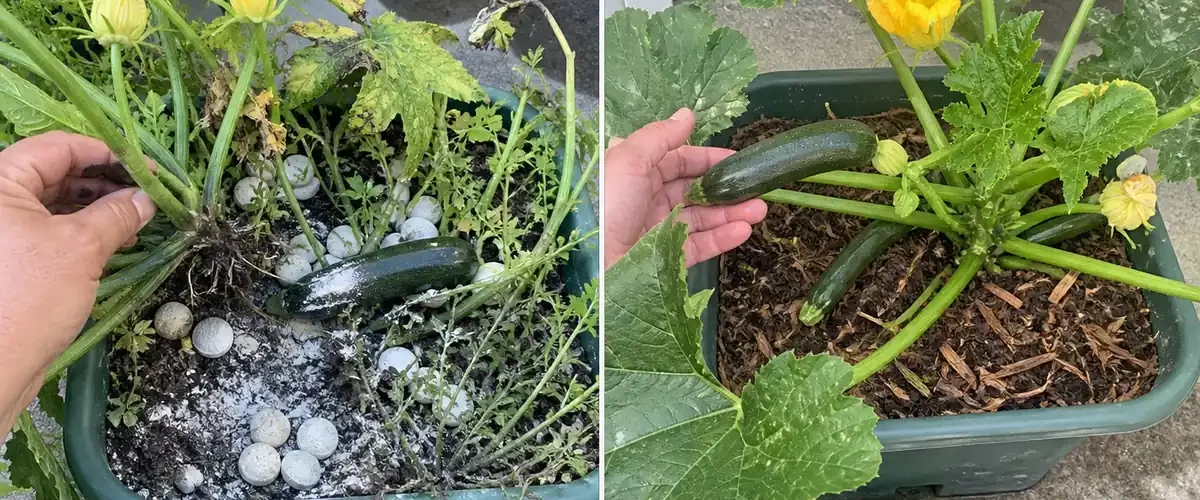
In a small home, kitchen, or garden, one struggling subject can dominate the whole space. Here the starting point is courgette roots receiving blended rice, activated charcoal tablets, eggs, rusks, soda, spices, and aloe on a monthly schedule. The source, Sprinkle it under the courgettes, they will grow endlessly – you will harvest a lot of them, answers it with a tempting promise: one kitchen mixture sprinkled under the roots makes courgettes grow endlessly and produce an exceptional harvest.
A compact space needs a method that earns its footprint. The plan below aims for vigorous vines and a bigger steady summer harvest, with steps that are tidy, measurable, and easier to stop if the result turns the wrong way. That is how a dramatic change becomes useful instead of merely photogenic.
What the Bold Courgette Harvesting Claim Leaves Out
Rice, charcoal tablets, raw egg, bread, and spices are not a balanced courgette plant food; food residue can attract pests, while poor pollination, uneven water, mildew, crowding, or missing nutrients usually limit fruit.
In limited space, a weak method creates odor, clutter, runoff, or repeated work very quickly. A cleaner sequence can still reach vigorous vines and a bigger steady summer harvest without adding a second problem.
Prove the Courgette Harvesting Result With More Than One Signal
Use one plant or container as the first courgette harvesting trial. Mark it discreetly and keep neighboring plants out so runoff, pests, shade, or a second treatment cannot confuse the result.
Repeat only after the test plant stays stable through normal care. In a small space, the best proof is vigorous vines and a bigger steady summer harvest with easy cleanup and no spillover into the rest of the room or garden.
Start Here: Give Each Plant Sun and Space
Look over sun hours, plant spacing, soil organic matter, drainage, leaf color, mildew, male and female flowers, pollinator activity, young fruit abortion, watering depth, and plant food history.
Clear a small courgette harvesting work zone and protect nearby floors, fabrics, plants, food, and shared air. Test one subject or one hidden area before treating the entire space.
Build the Result in Six Practical Moves
- Give each plant sun and space. Provide full sun, warm soil, airflow, and enough room for the mature leaves instead of crowding several plants around one feeding spot.
- Build balanced soil ahead of planting. Add finished compost and use a soil-guided or labeled vegetable plant food instead of raw food, tablets, or many unmeasured ingredients.
- Water deeply at the root zone. Keep moisture steady without wetting the foliage repeatedly, and use mulch when finished with the soil warms to slow extreme drying.
- Look at pollination each morning. Name female flowers by the tiny fruit behind them, encourage bees, and hand-pollinate with a fresh male flower when activity is low.
- Guard strong leaf spot. Take away only badly diseased tissue, improve airflow, and diagnose mildew, squash bugs, or nutrient symptoms ahead of spraying or feeding.
- Harvest small fruit often. Pick courgettes while tender and look over the plant every day or two so hidden oversized fruit does not slow the next harvest.
Why These Moves Create Vigorous Vines and a Bigger Steady Summer Harvest
Plants recover when roots, moisture, light, temperature, and nutrition are corrected in the right order. The first move, give each plant sun and space, sets the baseline. The next moves, build balanced soil ahead of planting and water deeply at the root zone, protect the living system that must create new growth.
The fifth move, guard strong leaf spot, supports the plant after the first visible change; the final move, harvest small fruit often, confirms its direction. Together they make vigorous vines and a bigger steady summer harvest a result of functioning roots and steady care rather than a short-lived surface effect.
A Believable Timeline for Vigorous Vines and a Bigger Steady Summer Harvest
Fix watering or hand pollination can guard new fruit immediately, while stronger leaves and roots take weeks. Harvestable courgettes develop quickly when finished with successful pollination in warm weather.
Keep the courgette harvesting setup steady while you wait. Repeatedly moving, feeding, watering, or repotting can hide which action helped and add fresh stress.
Four Mistakes That Block the Courgette Harvesting Result
- Avoid burying raw egg near roots. It makes the promised finish harder to separate from normal change.
- Avoid adding activated charcoal tablets as plant food. It risks trading a stable courgette harvesting result for a fast visual effect.
- Avoid feeding instead of checking pollination. It prevents a clean comparison with the original courgette harvesting baseline.
- Avoid promising endless production. It can spread residue, stress, or pests beyond the first courgette harvesting test.
Stop the Test if Any of These Limits Are Crossed
Keep food waste out of vegetable roots unless properly composted, store garden inputs labeled, wash harvested courgettes, and discard bitter fruit since unusual bitterness can signal unsafe cucurbitacins.
Keep the courgette harvesting area tidy, control runoff, and store every material away from food, children, and pets. Clean the work zone before normal care resumes.
Just One Application Brings More Courgettes Than You Can Pick: The Result Worth Keeping
The best small-space transformation is impressive because it stays controlled. Begin with give each plant sun and space, change one important condition at a time, and keep the routine only when it delivers vigorous vines and a bigger steady summer harvest without creating extra work nearby.